

Network documentation and modelling
Build a detailed, connected model of your electricity network
One connected network model
This core dpPower capability lets you document and visualize your electricity network in a structured model that brings together assets, geographic information, schematics, connectivity, and topology.
With the same network information available across planning, analysis, operations, and maintenance, teams can work from a consistent view of the network.
Document the network in maps and schematics
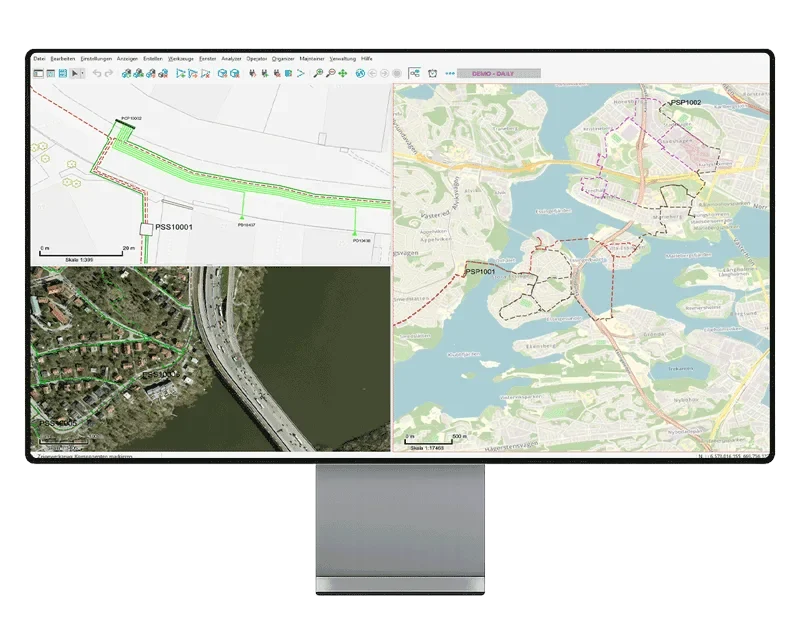
dpPower combines a purpose-built Geographic Information System (GIS) with Network Information System (NIS) functionality developed for electricity networks.
Document cables, overhead lines, substations, transformers, switchgear, and other network assets together with their attributes and relationships. Work with geographic maps to understand where infrastructure is located and schematics to see network structure and connectivity.
Both views are based on the same underlying network information, so you can work with the representation that best supports the task at hand.
Model how the network is connected
dpPower models more than the location of network assets. Objects are connected according to physical and logical design rules, creating a model of how the electricity network fits together.
Built-in topology and tracing capabilities help you investigate network relationships, connectivity, and feeding paths. Select a point in the network and trace connected elements, with the results highlighted directly in the network view.
The model supports electricity networks across different voltage levels, including radial and meshed networks and single- and multiphase grids. Separate representations of neutral and earthing are also supported.
Maintain consistent network information
As new connections are added, equipment is replaced, and the network is reinforced or redesigned, the network model needs to change with it.
Purpose-built quality-assurance algorithms validate network data from a network-topology perspective. Rule-based editing and templates provide additional support for consistent documentation and help maintain the integrity of the network model as changes are made.
Customer connection points and relevant meter and subscription information can also be related to the network, bringing infrastructure and connection information into the same environment.
Use the network model across the lifecycle
The connected network model provides an information foundation for work across dpPower.
Instead of maintaining separate representations for different processes, teams can work with connected network information throughout the electricity network lifecycle.
The model supports:
- Network planning and design
- Network analysis and capacity assessment
- Network tracing
- Projects and network changes
- Operations and outage management
- Maintenance
- Office and field collaboration
Explore other dpPower capabilities
Analysis, forecasting and energy transition
Perform network calculations, analyze capacity and future scenarios.
Operation and outage management
Distribution and outage management with fault location, isolation and restoration support.
Maintenance and asset management
Manage preventive maintenance and analyze results that drive maintenance decisions.
Projects, workflows and automation
Manage projects, plan resources and improve collaboration between teams.
Mobile workforce
View and edit network information and execute work and switch orders in the field.

See dpPower in action
Book a live demo to discuss your network challenges and see how dpPower can support your work, using scenarios relevant to your network.
Michael Brask
dpPower expert